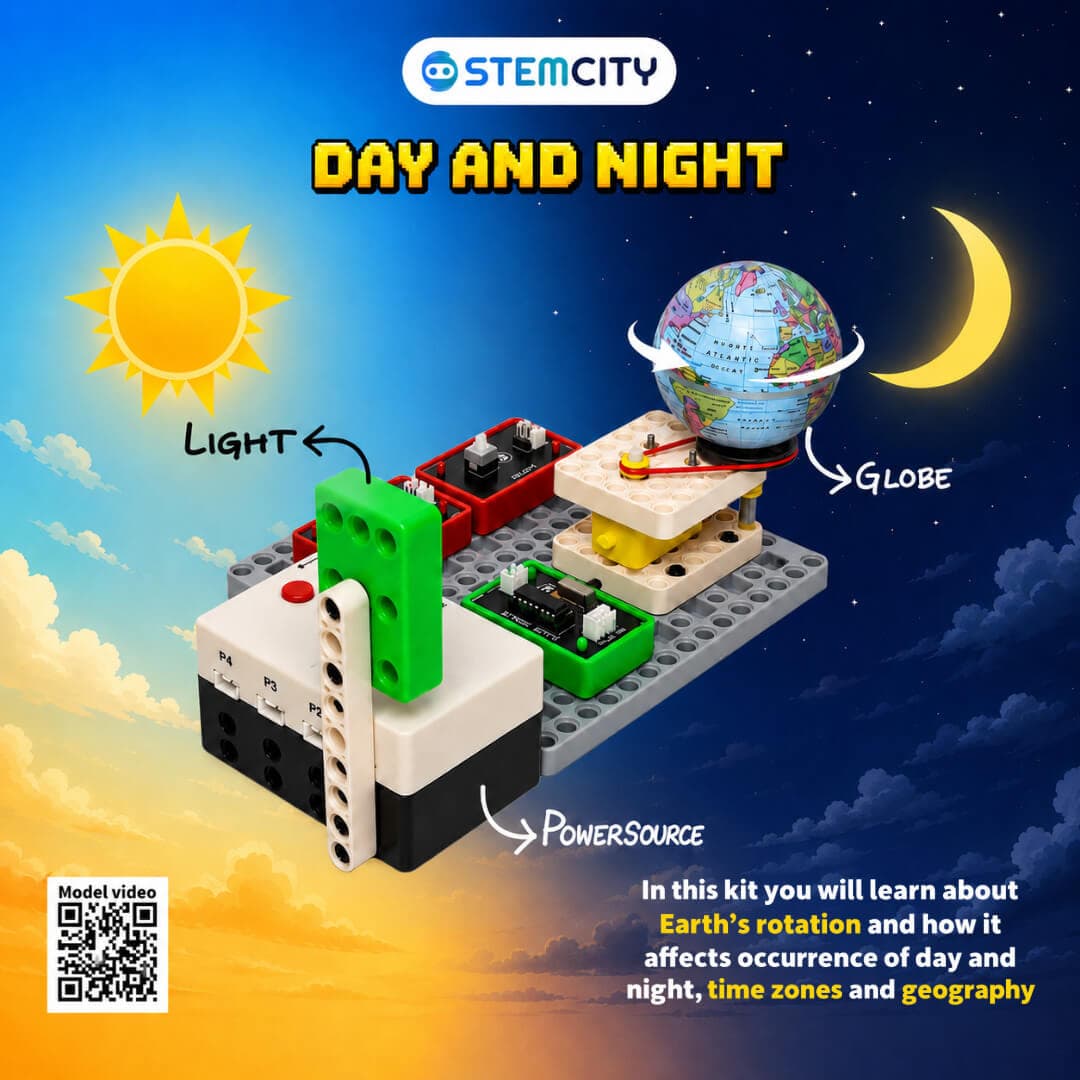
DIY Day and Night Project for school assignments and science exhibitions
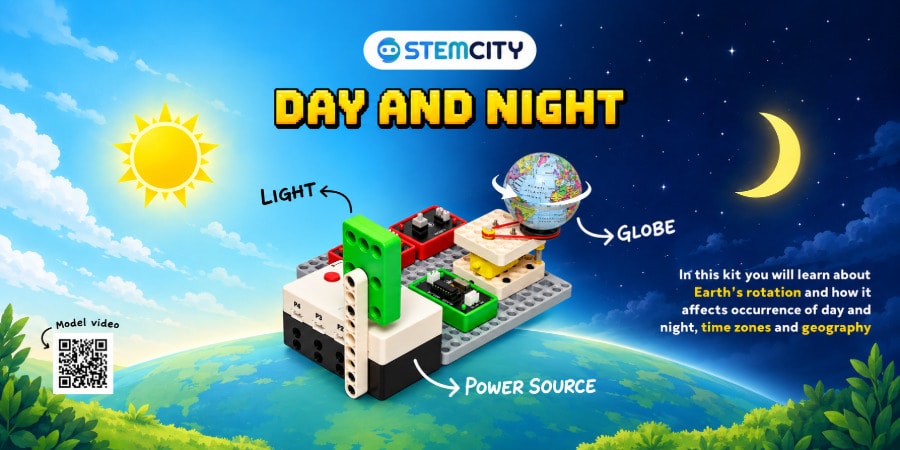
Table of Contents
Looking for a DIY day and night project for a school assignment or science exhibition? You can build one from scratch using everyday materials, and with the right components, you can even make it move!
But here’s something to consider: building a model that moves is one thing; building one that demonstrates the science clearly, has a well-organised mechanism, and is easier to assemble is another.
If you enjoy experimenting with cardboard, a globe, a motor, clay, wires, switches, glue, and paint, making your own model can be a fun experience. But if you’d prefer a more structured approach, with dedicated components, less craft-related mess, and a practical way to explore the science behind day and night, the STEMCity Day and Night Project is worth checking out.
The project comes with components that you can assemble by following the provided instructions. Once assembled, the Earth representation rotates in front of an LED light representing the Sun, helping you demonstrate how Earth’s rotation causes day and night.
What is the STEMCity day and night project?
The STEMCity Day and Night Project is a working science model that helps students explore the day-and-night cycle through hands-on learning.
While you can build a moving model at home, this project offers a more structured approach with dedicated components, including a motor, pulley mechanism, LED module, and Powernode controller.
Students can assemble the parts by following the provided instructions, observe how the mechanism works, and understand the science behind the model. It’s a practical option for school assignments, classroom activities, and science exhibitions.
How does the working model demonstrate day and night?
We’ve all learnt about day and night since we were little, haven’t we? The Sun provides light, and the Earth rotates on its axis. The side facing the Sun experiences day, while the side facing away experiences night.
Reading about it is one thing, but watching a working model makes the concept easier to visualise. That’s where the STEMCity Day and Night Project comes in!
The model uses an LED light to represent the Sun and a rotating Earth representation to demonstrate how day and night occur.
Here’s what you’ll observe:
- Day: The part of the Earth facing the light receives light and experiences daytime.
- Night: As that part rotates away from the light, it experiences nighttime.
- Sunrise and sunset: As the Earth rotates, locations move between darkness and light, representing sunrise and sunset.
The best part? Students can see how Earth’s rotation causes day and night instead of simply memorising the concept.
Features, Assembly and Learning Benefits
Building a DIY day and night project from scratch can be a fun way to experiment, but gathering materials, creating a stable structure, and getting the mechanism to work together can take time. The STEMCity Day and Night Project offers a more structured approach with dedicated components and an assembly manual to guide you through the process.
Key Features and Components
The project combines structural, mechanical, and electrical components to create a working science model. Here’s what makes it useful for school assignments and science exhibitions:
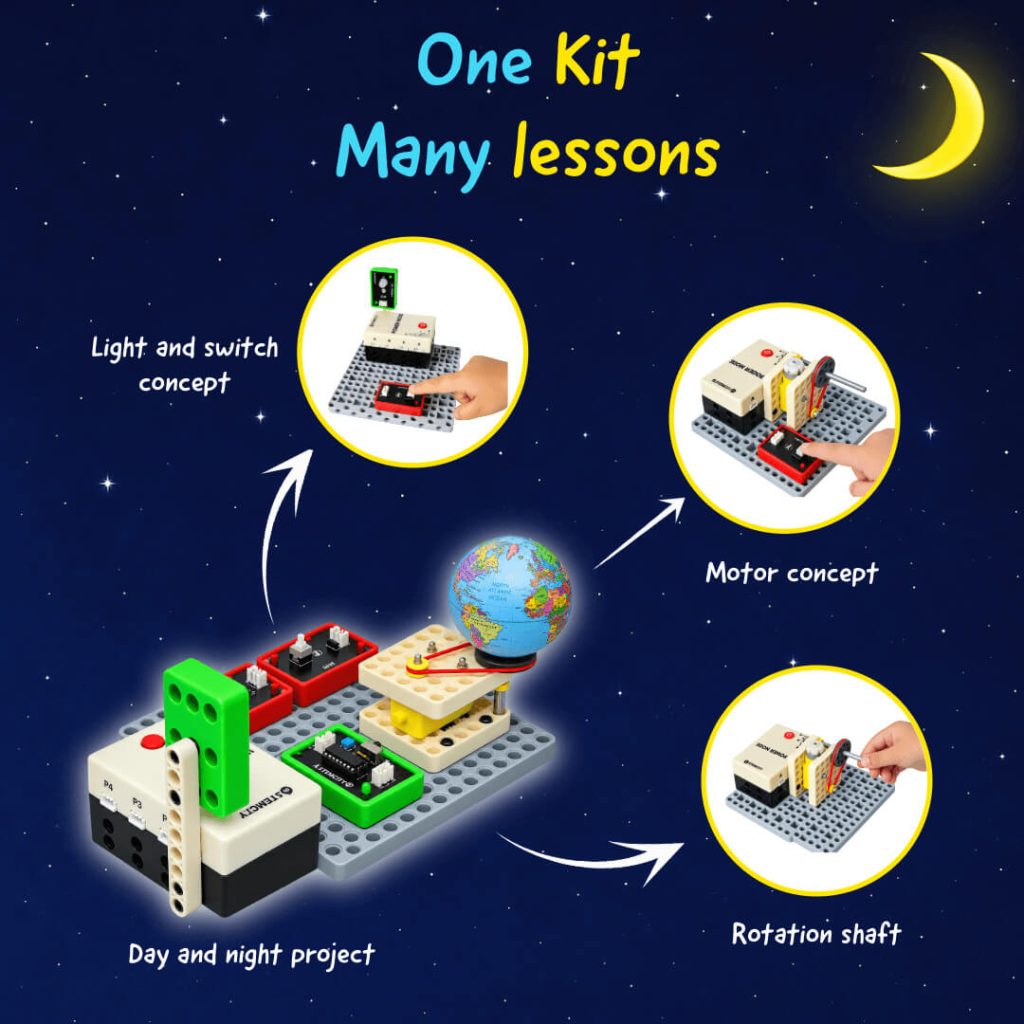
- Rotating Earth Model: A motor-driven mechanism rotates the Earth representation, allowing students to demonstrate the day-and-night cycle.
- Motor and Pulley Mechanism: These components work together to produce and transfer movement, introducing students to basic mechanical systems.
- LED Light Representing the Sun: The LED module provides the light source, helping students observe how Earth’s rotation relates to day and night.
- Dedicated Structural Components: The base plate, beams, and connector pegs help form the model’s structure, reducing the need to build everything from scratch using cardboard and craft materials.
- Electrical Components: The Powernode controller, switches, connecting wires, and power adapter form part of the model’s electrical setup and help operate it as described in the assembly instructions.
How to Assemble the Project
You don’t have to figure out the entire construction process on your own. The project comes with an assembly manual that guides you through arranging the structural parts, fitting the motor and rotation mechanism, positioning the Earth and LED modules, and making the required electrical connections.
Follow the instructions and connection diagrams carefully, and check that all components are fitted correctly before operating the model.
Access the assembly instructions here:
STEMCity Day and Night Project Manual
What Can Students Learn?
Beyond demonstrating day and night, the project gives students an opportunity to connect scientific concepts with practical construction. As they assemble and operate the model, they can develop several useful skills:
- Understanding Earth’s Rotation: Observe how different parts of the Earth representation move into and out of the light.
- Improving Observation Skills: Notice changes in the model, ask questions, and explain what they see.
- Exploring Mechanical and Electrical Systems: Understand how different components work together to operate a model.
- Developing Problem-Solving Skills: Follow instructions, identify components, and understand their roles in the completed project.
- Connecting Science and Engineering: Apply classroom learning through a hands-on activity that combines astronomy with practical engineering.
These experiences can help students explain the scientific principle behind their model with greater confidence during classroom activities and school science exhibitions.
Why choose a working model of day and night?
Choosing a school science project isn’t just about the concept; it’s also about the time, materials, and effort involved in building it. The STEMCity Day and Night Project offers dedicated components and a guided assembly process, making it a convenient option for students, parents, and schools.
Here are a few practical reasons to choose it:
- A Working Model, Not Just a Display: Retain the point about the motor-driven mechanism, but don’t explain how day and night occur again.
- Less Mess During Construction: Keep this focused on avoiding the need to create the whole structure from cardboard and craft materials.
- Dedicated Components: Keep this focused on having the structural and mechanical parts together in one project.
- Customisable and extendable: The project offers a foundation that students can build on, customise, and expand with additional ideas as they explore more STEM concepts.
With its dedicated components and guided assembly, the STEMCity Day and Night Project offers a convenient option for parents and schools looking for a ready-to-assemble working science model.
Explore the STEMCity Day and Night Project to bring a practical, interactive element to your next science activity.
Take It a Step Further: Add Your Own Creative Touch!
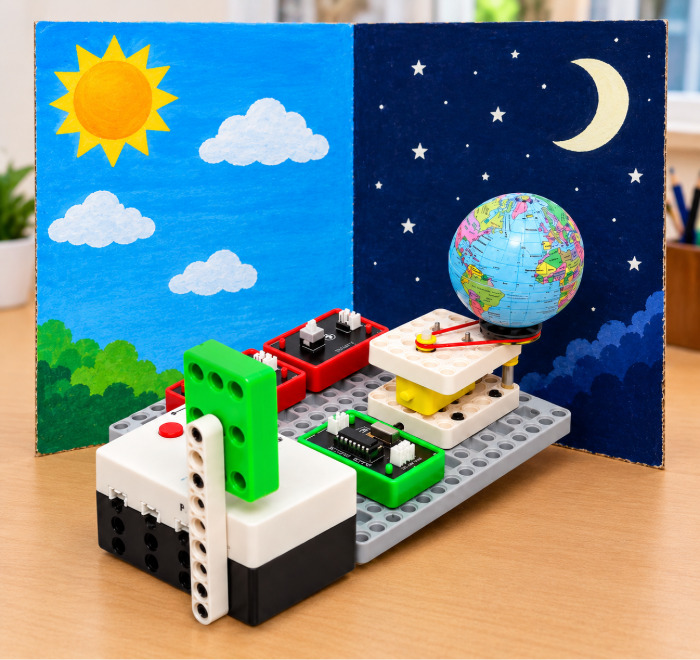
Love decorating your science projects? Here’s a fun idea! Take a piece of cardboard and paint one half in bright colours to represent daytime and the other half in black or dark blue to represent nighttime. You can add clouds, stars, and a bright Sun to make it look even more interesting.
Once your backdrop is ready, place the STEMCity Day and Night Project on it to create an eye-catching display. This not only makes your project look more attractive but also helps you explain the difference between day and night more clearly during your school science exhibition.
Frequently asked questions (FAQs)
1. What is the STEMCity Day and Night Project?
The STEMCity Day and Night Project is a working science model that demonstrates how Earth's rotation causes day and night. It uses a rotating Earth representation and an LED light representing the Sun to make the concept easier to understand.
2. How is this project different from a regular day and night model?
Unlike a stationary model, the STEMCity project uses a motor-driven mechanism to rotate the Earth representation. This allows students to observe how different parts of the Earth move between light and darkness.
3. Is the STEMCity Day and Night Project easy to assemble?
The project comes with dedicated components and an illustrated assembly manual to guide you through the process. Follow the instructions and connection diagrams carefully to assemble the model correctly.
4. Do I need Fevicol, glue, tape, or paint to assemble the model?
The project uses dedicated structural and mechanical components, so you don't need to build the entire model from scratch using cardboard and craft materials. This helps make assembly more organised and reduces the need for messy materials.
5. What components are included in the Day and Night Project?
The main components include a base plate, beams, connector pegs, an Earth model, an LED module, a motor, a pulley mechanism, a Powernode controller, switches, connecting wires, and a power adapter. Check the assembly manual for the complete component details and connection instructions.
6. Where can I find the assembly manual?
You can access theSTEMCity Day and Night Project assembly manual. It includes illustrated assembly instructions and connection charts to help you put the model together.
7. What can students learn from this project?
Students can understand Earth's rotation and the day-and-night cycle while exploring how motors, pulleys, and electrical components work. Assembling the model also gives them practical experience with following instructions and putting components together.
8. Can the project be used for a school science exhibition?
Yes! Once assembled correctly, the model can be used for school science exhibitions and classroom demonstrations. Students can operate it to demonstrate the day-and-night cycle and explain how the model works.