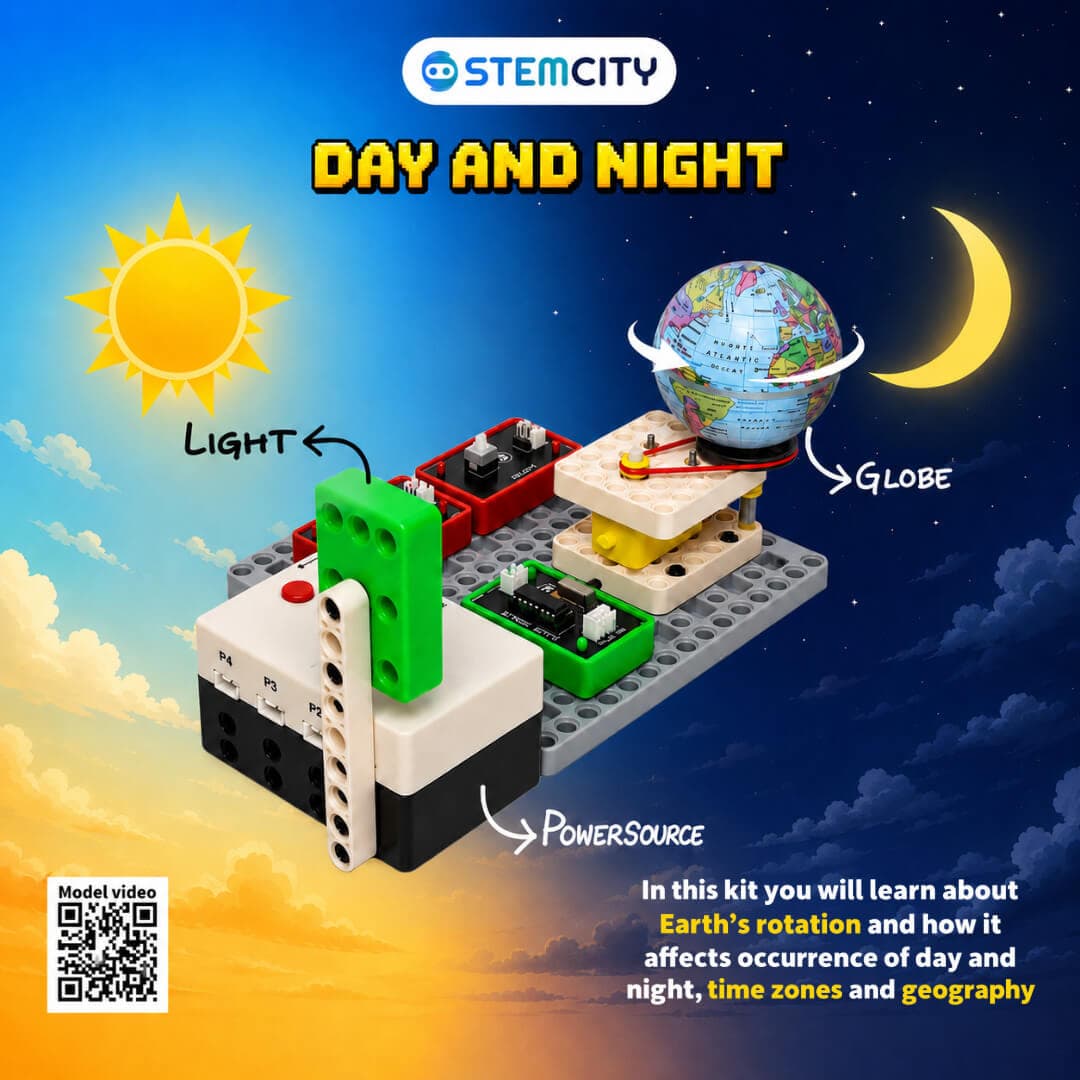
Day and Night Project Science Model for Kids
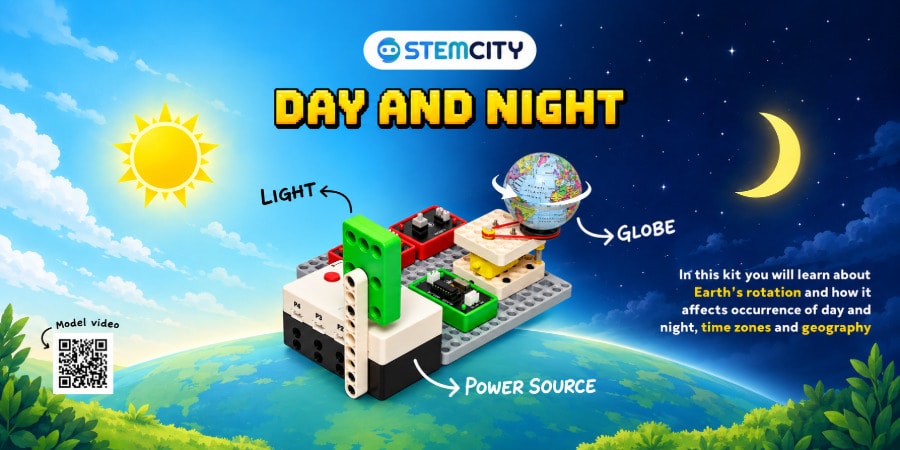
Table of Contents
Have you ever wondered why the Sun appears in the sky during the day and disappears at night? Why do we wake up in the morning, go to school during the day, and sleep when it gets dark?
The answer lies in the rotation of the Earth.
Earth is constantly spinning on its axis. As it rotates, different parts of the Earth face towards the Sun and then gradually turn away from it. The side facing the Sun experiences day, while the side turned away from the Sun experiences night.
For children, understanding this concept only through a textbook or diagram can sometimes be difficult. A hands-on day night project can make the idea much easier to understand. By creating a Working Model of Day and Night, students can observe how Earth’s rotation causes the transition from day to night and then from night to day again.
This type of science project combines astronomy, observation, and practical learning in a simple and engaging way.
What Is the Day and Night Project?
The day and night project is a working model that demonstrates how Earth’s rotation creates the cycle of day and night.
The model generally uses a representation of the Earth along with a light source representing the Sun. When the Earth model rotates, one side is illuminated while the other side remains in darkness.
As the Earth continues to spin:
This continuous cycle helps students understand that day and night are not caused by the Sun moving around the Earth each day. Instead, they occur because the Earth rotates on its axis.
A physical model makes this process easier to visualise because students can actually watch one part of the Earth move from the lighted side into darkness and then back into the light.
Why Does Day and Night Occur?
The Earth receives light from the Sun. However, the entire Earth cannot receive sunlight at the same time.
Earth is approximately spherical, so when sunlight falls on it, one half of the Earth is illuminated while the other half is facing away from the Sun.
At the same time, Earth rotates continuously on its axis.
The side facing the Sun experiences daytime.
The side facing away from the Sun experiences nighttime.
As Earth rotates, locations gradually move from the daylight side to the darker side and then back towards the sunlight side.
This is why day changes into night and night changes into day.
The Role of Earth’s Rotation
Earth rotates around an imaginary line called its axis. The axis passes through the North Pole and South Pole.
Earth takes approximately 24 hours to complete one rotation.
This rotation creates the regular cycle of:
- Morning
- Daytime
- Evening
- Night
- Morning again
The movement may seem slow when we observe Earth from our everyday surroundings, but the planet is constantly rotating.
The day-night project provides a simple way for students to represent this movement. When they rotate the Earth model around its axis while keeping the light source fixed, they can see how the illuminated and dark regions change.
How the Working Model of Day and Night Works
The Working Model of Day and Night is based on a simple idea: a light source represents the Sun, while a globe or spherical object represents Earth.
The light source remains in one position, while the Earth model rotates.
When a particular part of the model faces the light source, that part represents daytime. When it rotates away from the light source, it enters the darker region and represents nighttime.
As the rotation continues, the same location eventually returns to the illuminated side.
This demonstrates the complete cycle:
Sunlight → Day → Rotation → Night → Rotation → Day
The model allows children to observe this cycle rather than simply memorising it.
Materials Required
A simple science project on day and night can be created using easily available materials.
Depending on the design, students may use:
- A small globe or ball to represent Earth
- A lamp, LED, or torch to represent the Sun
- A stand or support structure
- A stick or rod to act as Earth’s axis
- Cardboard or a base for support
- Wires or connectors, if required
- Decorative materials
- Labels for Earth, Sun, Day, and Night
The exact materials can be changed according to the age of the students and the design of the model.
The objective is not to make the model complicated. The most important feature is that the Earth representation should be able to rotate, allowing students to demonstrate the change between day and night.
Building the Day Night Working Model
Our Day Night Project is not just a static display. It is a working model designed using different building and mechanical components that allow the Earth model to rotate and demonstrate the cycle of day and night.
The model combines a base plate, beams, Powernode controller, motor and gear mechanism to create the rotating movement. This gives students an opportunity to understand not only the science behind Earth’s rotation but also how mechanical components can be used to demonstrate a scientific concept.
Components Used in the Model
The main components used to build the model include:
- Base Plate: Provides a stable foundation for the complete model and supports the different components.
- Beams: Used to create the supporting structure and hold the model and its components in position.
- Powernode Controller: Acts as the controller for the motor and helps operate the mechanical movement of the model.
- Motor: Provides the power needed to create rotational movement.
- Gear Mechanism: Transfers the movement from the motor and helps rotate the Earth model in a controlled manner.
- Earth Model: Represents our planet and rotates to demonstrate the transition between day and night.
- Light Source: Represents the Sun and provides the light needed to show which side of Earth is experiencing daytime.
How the Rotation Mechanism Works
The most interesting part of this Working Model of Day and Night is the mechanism that makes the Earth rotate.
The motor provides the initial rotational movement. This movement is transferred through the gear mechanism, which controls and transfers the rotation to the Earth model.
The gears work together to produce a smooth and controlled movement. The Powernode controller helps operate the motor, allowing the model to demonstrate Earth’s rotation in a simple and engaging way.
As the Earth model rotates, different sides move towards and away from the light source.
Light-facing side → Day
Rotating away → Sunset
Away from the light → Night
Rotating towards the light → Sunrise
Light-facing side again → Day
This creates the complete cycle:
Day → Sunset → Night → Sunrise → Day
Connecting Engineering with Science
One of the interesting aspects of this project is that students are not only learning about astronomy. They are also seeing how mechanical engineering and technology can be used to demonstrate a scientific concept.
The project brings together several ideas:
Science: Earth’s rotation and the day-night cycle
Engineering: Gears, beams, and mechanical movement
Technology: Motor and Powernode controller
Design: Building a stable and functional working model
This makes the project a practical example of STEM learning, where students can see how different areas of knowledge can work together to solve a problem or demonstrate an idea.
Rather than simply showing a picture of Earth, the model allows students to build, operate, observe, and explain the process themselves.
Step-by-Step Working Model of Day and Night
The working of the model can be explained in a few simple steps.
Step 1: Represent the Sun
Place a lamp or another suitable light source in a fixed position. This represents the Sun.
The light source should remain stationary during the demonstration.
Step 2: Represent the Earth
Use a globe or ball to represent Earth.
Mark a few locations on it so students can observe what happens to a particular place as the Earth rotates.
Step 3: Add Earth’s Axis
Place a rod through the model to represent Earth’s axis.
The axis provides the central line around which the Earth rotates.
Step 4: Start the Rotation
Rotate the Earth model slowly while keeping the light source fixed.
The side facing the light will be illuminated, representing daytime.
Step 5: Demonstrate Night
Continue rotating the Earth.
The marked location will gradually move away from the light source and enter the darker region.
This represents nighttime.
Step 6: Complete the Cycle
Continue the rotation until the same location faces the light source again.
The location experiences daytime once more.
This demonstrates how Earth’s continuous rotation creates the repeating cycle of day and night.
What Do Children Learn from This Project?
A day and night project is more than a decorative school model. It can help students understand an important astronomical concept through observation and experimentation.
Through the model, children can learn:
- Earth rotates around its axis.
- The Sun provides the light that illuminates Earth.
- The side of Earth facing the Sun experiences day.
- The side facing away from the Sun experiences night.
- Earth takes about 24 hours to complete one rotation.
- Day and night occur because of Earth’s rotation.
- Different places on Earth experience daylight and darkness at different times.
- The day-night cycle repeats continuously.
The hands-on nature of the model also encourages students to ask questions and observe what changes when the Earth is rotated.
From Daylight to Darkness: Understanding the Transition
One interesting part of the model is observing that day and night do not need to be treated as two completely separate events.
As Earth rotates, a location gradually moves towards the edge of the illuminated region.
In real life, this corresponds to sunset.
As the location moves further away from the Sun-facing side, the sky becomes darker and night begins.
Later, as Earth continues to rotate, the location approaches the illuminated region again. This corresponds to sunrise.
Therefore, the model can be used to explain the complete transition:
Day → Sunset → Night → Sunrise → Day
This makes the project especially useful for explaining the daily cycle that students experience themselves.
What Is Circadian Rhythm?
The day-night cycle is also connected to the natural biological rhythms of living organisms.
One important example is the circadian rhythm.
Circadian rhythms are approximately 24-hour biological cycles that influence many processes in living organisms. In humans, these rhythms are closely connected with the regular pattern of light and darkness.
For children, this can be explained through familiar examples.
During the daytime, we generally:
- Wake up
- Go to school
- Study
- Play
- Participate in activities
At night, our routine generally changes. We prepare for sleep, and our bodies follow a different pattern.
The regular cycle of light and darkness helps our bodies maintain these daily patterns.
How Does the Day-Night Cycle Affect Our Daily Routine?
Our lives are closely connected with the Earth’s day-night cycle.
Think about a normal school day.
Morning: We wake up and prepare for school.
Daytime: We attend classes, learn, play, and participate in activities.
Evening: We return home, complete our work, and spend time with family.
Night: We prepare for sleep and allow our bodies to rest.
This repeated pattern is connected to the natural cycle of light and darkness.
When students build a Working Model of Day and Night, they can therefore connect an astronomy concept with something they experience every day.
Why Is This a Good Science Project for Students?
A good school project should encourage students to understand a concept rather than simply decorate a model.
The day-night project provides an opportunity for students to combine science with creativity and practical learning.
It helps students:
1. Learn Through Observation
Instead of simply reading that Earth rotates, students can actually observe how rotation changes the illuminated part of the model.
2. Understand Abstract Concepts
Earth’s rotation is difficult to observe directly because we are living on Earth. A working model provides a simple visual representation.
3. Develop Scientific Thinking
Students can make observations, ask questions, predict what will happen, and test their understanding by rotating the model.
4. Connect Science with Daily Life
The project connects Earth’s movement with familiar experiences such as sunrise, sunset, daytime, nighttime, and sleep.
5. Improve Presentation Skills
Students can explain the model to classmates, teachers, or visitors during a science exhibition.
How Students Can Explain the Project
When presenting the day and night project, students can explain it in a simple sequence.
They can begin by saying:
“This model demonstrates how the rotation of the Earth causes day and night.”
They can then point towards the light source and explain:
“The light represents the Sun. The side of Earth facing the light experiences daytime.”
Next, they can rotate the Earth model:
“As Earth rotates, this location moves away from the Sun and enters darkness. This represents nighttime.”
Finally, they can continue rotating the model:
“As Earth completes its rotation, the same location comes back into the light. This represents the beginning of another day.”
Students can also introduce circadian rhythm by explaining that the regular pattern of light and darkness is connected with the approximately 24-hour biological cycles of living organisms.
Questions Students Can Explore
A hands-on project can lead to many interesting questions.
For example:
- Why does the Earth have day and night?
- Does the Sun move around Earth every day?
- How long does Earth take to rotate once?
- Why is one side of Earth dark while another side is bright?
- What happens during sunrise?
- What happens during sunset?
- Why do different places experience different times of day?
- How is our daily routine connected with light and darkness?
- What is circadian rhythm?
- What would happen if Earth stopped rotating?
These questions can turn a simple model into an opportunity for deeper scientific discussion.
Common Misconception: The Sun Moves Around Earth
One common misunderstanding among young learners is that the Sun moves around Earth to create day and night.
The apparent movement of the Sun across the sky is related to Earth’s rotation.
From our viewpoint on Earth, the Sun appears to rise in the east, move across the sky, and set in the west. However, the day-night cycle itself is caused by Earth rotating on its axis.
The Working Model of Day and Night helps students understand this difference because the Sun remains fixed in the model while Earth rotates.
Making the Project More Interactive
Teachers and parents can make this science project more engaging by asking students to participate in the demonstration.
For example, a teacher can mark a particular city or location on the globe and ask:
“Is this location experiencing day or night right now?”
The student can then rotate the Earth and observe how its position relative to the light source changes.
Another activity is to ask students to predict what will happen before rotating the model.
For example:
“What will happen to this location when it moves away from the light?”
Students can make a prediction and then test it using the model.
This simple approach introduces the idea of prediction, observation, and verification, which are important parts of scientific thinking.
From a Simple Model to a Bigger Idea
The day and night cycle may appear to be a simple topic, but it introduces students to several important scientific ideas.
They learn about:
Earth → Rotation → Sunlight → Day and Night → Daily Patterns → Circadian Rhythm
The project can therefore connect astronomy with biology and everyday life.
It also demonstrates how a simple physical movement can produce a predictable natural cycle.
Conclusion
A day night project is a simple yet effective way to help children understand one of Earth’s most familiar natural cycles.
By using a Working Model of Day and Night, students can see how Earth rotates on its axis and how different parts of the planet move between sunlight and darkness. Instead of simply memorising that Earth’s rotation causes day and night, they can observe the process and explain it in their own words.
The project can also introduce children to circadian rhythm and help them connect the science of Earth’s rotation with their own daily routines of waking, learning, playing and sleeping.
Most importantly, a hands-on science project like this encourages children to ask questions, observe changes, and learn through experimentation.
Sometimes, the best way to understand a concept is not just to read about it, but to build it, rotate it, and watch the science happen.
FAQs
Why is a working model better than a simple diagram for explaining day and night?
A diagram can display the light and dark sides of the Earth, but a functional model allows students to observe the changing of these areas when the representation of the Earth is rotated. Students can have a better idea of the process by placing a point on the globe and watching its movement toward and away from the light source. The hands-on method fosters active engagement, allows students to describe the subject in their own terms, and makes the project more interesting for classroom demonstrations and science exhibitions.
What is circadian rhythm, and how is it related to day and night?
The circadian rhythm is the body’s inherent biological time system. It is roughly on a 24-hour cycle and regulates things like sleep and wakefulness. In humans and many other living things these rhythms are controlled by the natural cycle of light and dark. This link can be introduced by a day and night project that helps kids comprehend how rotation of the Earth causes the daily cycle of light and dark that affects habits such as waking up, going to school, playing and sleeping.
How is a day and night project connected to STEM learning?
Science, technology, engineering, and design in one hands-on project, day and night. Students analyze the scientific theory behind Earth’s rotation, explore how a light source may illuminate a spherical object, and investigate how motors and gears can cause rotational movement. It is also an excellent example of an integrated STEM project since building and operating the model stimulates problem-solving, creativity, observation and practical learning.
What do students learn from a day and night science project?
Students learn that the Earth spins on its axis and that this spinning explains the regular cycle of day and night. They also find out more about the Sun as a source of light and why it is that different places on Earth have day and night at different times. The model also allows students to examine basic mechanical engineering, movement and practical use of STEM ideas, with a motor, gears and a controller.
What makes a day and night project suitable for school science exhibitions?
A day and night project is perfect for classroom science exhibitions since it demonstrates an important scientific subject with a visual and interactive model. Students can describe Earth’s rotation, exhibit the change from day to night, and show how mechanical parts such as motors and gears can help with movement. A motorized version also offers the ability to combine astronomy with engineering and technology, helping students to show both the scientific principle and mechanism behind the model.